Recommendation
- 330,270 synthetic events across 15,000 users and 600 products
- Hybrid Recall@10: 0.2658
- Hybrid NDCG@10: 0.1374
Machine Learning Engineering
University of Washington · ECE + Data Science
Machine Learning · Multimodal Retrieval · Recommendation Systems · Computer Vision
Available June–September 2027
I build machine learning systems across recommendation, retrieval, computer vision, and deployment.
My recent work includes an e-commerce search and recommendation platform, tiny-object detection research, and real-time vision deployment on NVIDIA Jetson.
At a glance
About
I am pursuing dual bachelor's degrees in Electrical & Computer Engineering and Applied Mathematics: Data Science at the University of Washington, with expected graduation in December 2027 and a GPA of 3.80 / 4.00.
I like problems where modeling decisions, evaluation design, and systems engineering all matter. My embedded-systems background makes me especially attentive to latency, data provenance, failure modes, and the gap between an offline metric and a working deployment.
Research & Experience
ARC Lab, University of Washington · Seattle, WA
University of Washington · EE/CSE 474: Embedded Systems
Shenzhen Volcos Technology Co., Ltd. · Shenzhen, China
Selected Projects
Search & Recommendation · May 2026–Present
Built an end-to-end e-commerce ML system combining personalized recommendation, multimodal product retrieval, and grounded product search.
Recommendation: Hybrid ranking reached 0.2658 Recall@10 and 0.1374 NDCG@10 on a frozen temporal test.
Multimodal retrieval: Image-to-product retrieval reached 0.8929 Recall@10 and 0.7811 MRR on 1,000 public Amazon Berkeley Objects products.
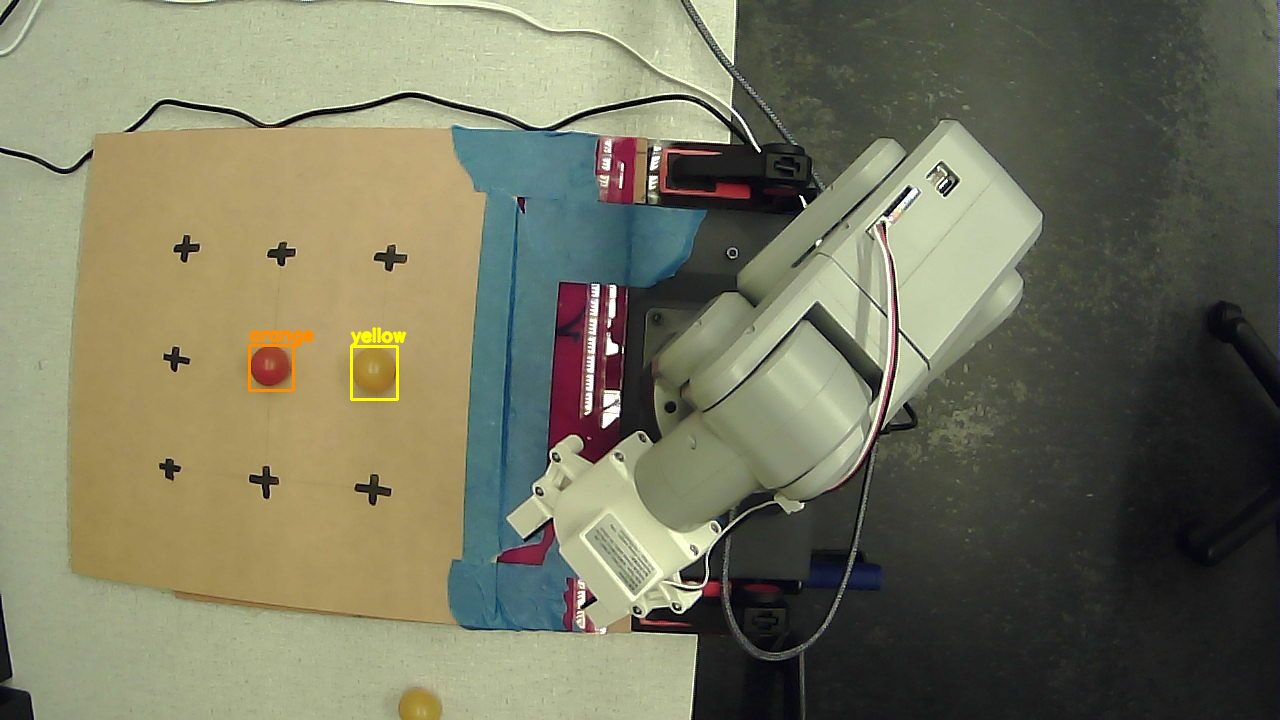
Edge ML & Robotics · Jun 2026–Present
Built an edge perception and robotic sorting system on NVIDIA Jetson Orin Nano, sending vision-derived targets over TCP/IP to a Raspberry Pi-controlled mechArm with rescanning, placement verification, relocalization, and recovery.
Measured result: FP16 TensorRT improved learned-model throughput from 20.83 to 27.57 FPS; separate physical testing with the OpenCV/HSV backend achieved 18/18 grasps, 15/18 vision-verified placements, and 2/2 recoveries.


Robotics Modeling
Implemented a Python workflow for 6-DOF manipulator modeling with Denavit–Hartenberg parameters, forward kinematics, numerical inverse kinematics, and pick-and-place trajectory generation.
View repository →
Embedded Systems
Built a real-time ESP32-S3 prototype with interrupt-driven ultrasonic sensing, hardware timers, buffered sensor logic, and state-machine motor control.
View repository →Technical Skills
Python, SQL, C++, Java, JavaScript, C, Bash
PyTorch, Recommendation Systems, Information Retrieval, Multimodal Retrieval, SigLIP2, FAISS, BM25, RRF, Grounded RAG, LLM Tool Use, Weights & Biases, ONNX, Ranking, Model Evaluation, OpenCV, NumPy, Pandas, SciPy, model training, hard-example mining, domain adaptation, Ultralytics YOLO
Docker, GCP Cloud Run, GitHub Actions, OIDC, Linux, Git, Node.js, TensorRT, CUDA, TCP/IP, SSH, NVIDIA Jetson Orin Nano, Raspberry Pi, FreeRTOS
Temporal validation, leakage auditing, ablation design, ranking evaluation, reproducible pipelines, physical-system testing
2027 Internship Search
I am especially interested in recommendation and ranking systems, computer vision, edge ML, and roles where disciplined evaluation connects directly to product or physical-system behavior.
Recruiter Contact
If you are hiring for machine learning, recommendation systems, computer vision, or edge AI roles, send me a note.